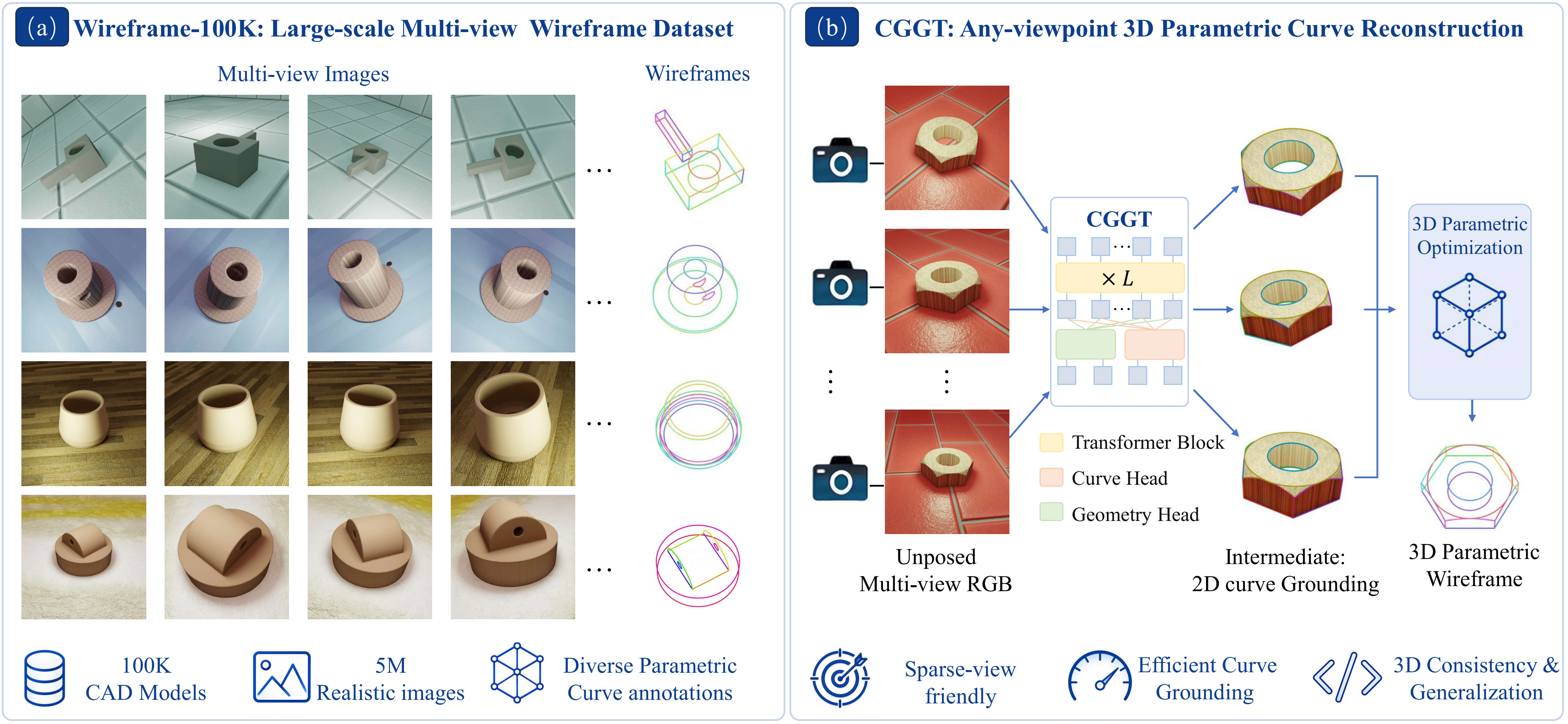
Curve grounding, not edge chasing
Instance-level queries identify the same structural curve across views instead of fitting every visible image edge.
Sparse-view structured 3D reconstruction
From casually captured RGB images to compact, editable 3D parametric curves—without calibrated cameras, precomputed edge maps, or costly per-scene reconstruction.
Overview
Recovering editable 3D parametric curves from 2D images is a fundamental challenge in computer graphics, bridging pixel-based perception and vector-based CAD modeling. Existing NeRF- and 3DGS-based methods often rely on dense calibrated views, precomputed 2D edge maps, and costly per-scene optimization, limiting their applicability to casually captured real-world inputs.
We propose CGGT, a Curve-Grounded Geometry Transformer that directly grounds 3D-consistent 2D curve instances in image space from sparse, unposed multi-view images. CGGT combines a geometry-aware transformer encoder for multi-view feature learning with a curve-aware masked-attention decoder for cross-view instance association. In one forward pass, it predicts camera parameters, dense depth maps, and instance-level 2D curve masks. These predictions are lifted into 3D and refined through fast parametric optimization to recover compact, editable curve primitives.
Trained only on the proposed Wireframe-100K synthetic dataset, CGGT generalizes to real-world images and separates persistent structural curves from view-dependent edges caused by silhouettes, textures, shadows, and appearance variations.
Instance-level queries identify the same structural curve across views instead of fitting every visible image edge.
Camera, depth, appearance, and curve predictions share multi-view features, enabling sparse and unposed inputs.
Lifted observations initialize lines, ellipses, and Bézier curves that remain editable in downstream CAD workflows.
Method
CGGT first solves the better-constrained image-space association problem, then recovers continuous 3D geometry through lightweight optimization.

static/images/pipeline.png
Export from figs/pipeline.pdf
Wireframe-100K
Wireframe-100K couples realistic multi-view observations with parametric 3D wireframes, instance-level 2D curve masks, and persistent identities across views. It supports learning object-level curve priors instead of relying only on local image edges.
Access Wireframe-100K
static/images/multiview.png
Export from figs/mv_cropped.pdf
Visual Results
The visual comparisons highlight cross-view consistency, suppression of appearance-induced edges, and compact parametric reconstructions.

static/images/qualitative.png
Export from figs/vis-cggt.pdf

static/images/real.png
Export from figs/real.pdf
Citation
@inproceedings{gao2026cggt,
  title     = {CGGT: Curve-Grounded Geometry Transformer for Structured Curve Reconstruction from Unposed Sparse Views},
  author    = {Gao, Zhirui and Yi, Renjiao and Hu, Ruizhen and Ye, Yunfan and Zhu, Chenyang and Chen, Wei and Xu, Kai},
  booktitle = {SIGGRAPH Asia 2026 Technical Papers},
  year      = {2026}
}This work is supported in part by the NSFC (62325211, 62132021, 62572477, 62522219, 62372457, 62322207), the Research Fund of Jiangsu Key Laboratory of AI for Industries (E6420016G8), the Young Furong Scholar Support Program of Hunan Province, and the National Natural Science Foundation of China (62402171).